Systems Risk Advisory Publications

Practical cybersecurity books for water, wastewater, and critical infrastructure leaders.

Systems Risk Advisory publishes practical guides that help utility leaders, operators, IT staff, OT teams, public works professionals, and emergency managers reduce risk without getting buried in theory.

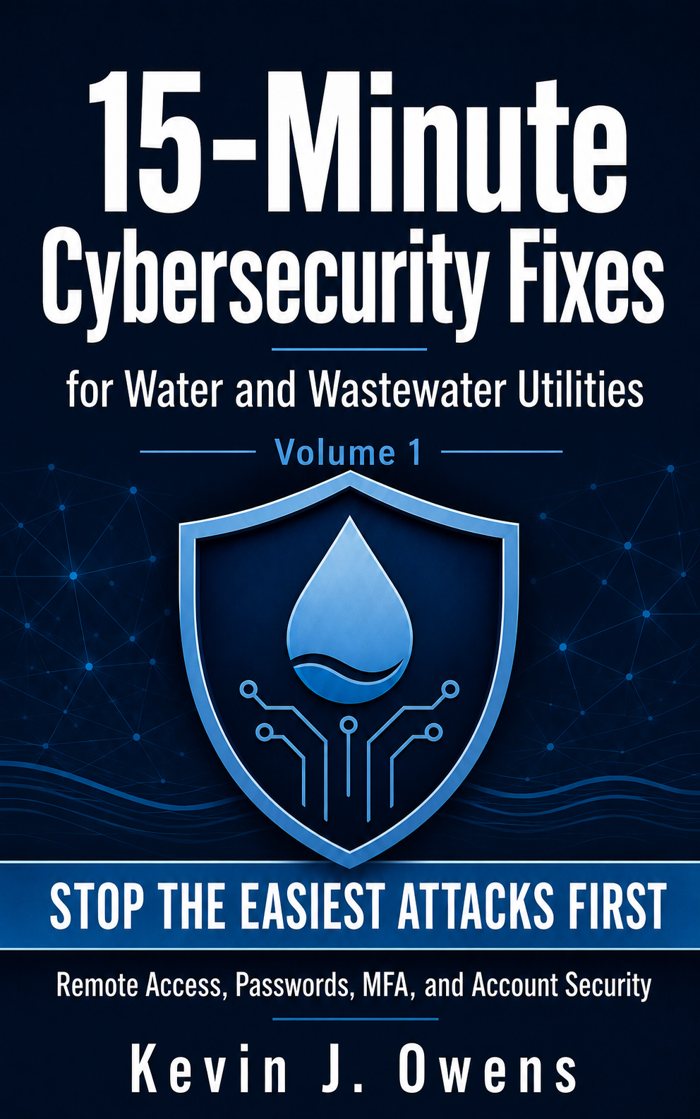
Book cover: 15-Minute Cybersecurity Fixes for Water and Wastewater Utilities, Volume 1, by Kevin J. Owens

About the Book Program

The Systems Risk Advisory book program is built for organizations that operate essential services and need clear, practical cybersecurity guidance. The books are written for real utility environments where staff time is limited, budgets are constrained, and operational continuity matters.

The initial series focuses on water and wastewater utilities. Future publications may expand into incident response, tabletop exercises, OT/ICS resilience, public works, emergency planning, and executive risk decision-making.

15-Minute Cybersecurity Fixes for Water and Wastewater Utilities

15-Minute Cybersecurity Fixes is a practical series for water and wastewater personnel who need to reduce common cyber risks in manageable steps. Each volume focuses on a bounded set of actions that can be started quickly, assigned clearly, and tracked over time.

The series is designed for utility managers, operators, IT staff, OT and SCADA personnel, public works directors, emergency managers, and local leaders who need practical improvements without turning every issue into a major project.

Featured Release

Primary launch volume
Volume 1: Stop the Easiest Attacks First

Remote Access, Accounts, Backups, and Basic Cyber Hygiene for Water and Wastewater Utilities

Volume 1 helps utilities focus on the common weaknesses that attackers often use first. It emphasizes practical review steps, account cleanup, remote access controls, backup checks, and action tracking.

Planned and Future Publications

The first publication path focuses on water and wastewater cybersecurity. Additional guides can be added as final titles, covers, release dates, and links are confirmed.

Volume 2

Planned topic: phishing, email security, and staff awareness for utility environments.

Volume 3

Planned topic: vendor access, remote support, and third-party risk.

Volume 4

Planned topic: the human side of water cybersecurity, including trust, training, and decision-making.

Volume 5

Planned topic: ransomware readiness, containment, recovery, and continuity of operations.

Future Guides

Potential topics include tabletop exercises, incident response planning, OT/ICS segmentation, AWIA support, physical security, and executive cyber risk briefings.

Who the Books Are For

For Utility Leaders

Use the books to understand risk, assign practical work, brief boards, and make defensible improvement decisions.

For Operators and Public Works Teams

Use the checklists and steps to identify issues that affect daily operations, service continuity, and response readiness.

For IT, OT, and SCADA Staff

Use the series to review remote access, accounts, backups, vendor connections, network exposure, and incident preparation.

For Training and Workshops

Use the books and toolkits as a foundation for staff briefings, short workshops, and tabletop exercise preparation.

How Organizations Can Use These Books

  • Support internal cybersecurity improvement efforts.
  • Give boards and executives a clearer view of common utility risks.
  • Create simple action lists that can be assigned and tracked.
  • Prepare staff for tabletop exercises and incident response planning.
  • Connect book topics to consulting, workshops, and practical implementation support.

Books, Toolkits, Workshops, and Consulting

The book series can stand alone, but it also supports SRA training, workshops, tabletop exercises, and consulting engagements. A utility can use a book to start internal work, then request support when it needs facilitation, technical review, leadership briefing, or a documented improvement plan.

Use the books as a starting point for practical risk reduction.

Contact Systems Risk Advisory to discuss workshops, staff briefings, tabletop exercises, or consulting support connected to the book series.